Databricks brings GPT-5.5 to enterprise agent workflows
Databricks has integrated GPT-5.5 into its enterprise agent workflows, leveraging the model's new state-of-the-art performance on the OfficeQA Pro benchmark to enhance corporate automation.
The latest from the AI and MCP ecosystem, curated daily.
This week marked a decisive shift from general AI capabilities toward the rigorous engineering of agentic infrastructure and vertical integration. The narrative was dominated by a push to make AI agents reliable, secure, and deeply integrated into professional environments.
A primary theme was the creation of stable "homes" for agents. OpenAI unveiled a secure Windows sandbox for Codex to solve safety bottlenecks, while Cursor introduced Dockerfile-based configurations for cloud agent environments. Anthropic furthered this with "Agent View" in Claude Code, allowing developers to manage multiple concurrent sessions, and shared critical best practices for reliable browser and computer use.
We saw AI moving beyond general assistants into high-stakes professional workflows. Anthropic’s aggressive expansion into the legal industry—via 20+ new MCP connectors and specialized plugins—demonstrates how the Model Context Protocol (MCP) is becoming the standard for operating within professional software suites. Simultaneously, the general availability of the Claude Platform on AWS and Databricks’ integration of GPT-5.5 into enterprise workflows signal that "AI-ready" infrastructure is now a baseline requirement for the enterprise.
Beyond agents, technical gains continued with IBM’s Granite Embedding Multilingual R2 offering high-quality retrieval in a sub-100M parameter package, and Hugging Face researching asynchronicity in continuous batching to drive higher LLM inference throughput.
Key Stories:

Databricks has integrated GPT-5.5 into its enterprise agent workflows, leveraging the model's new state-of-the-art performance on the OfficeQA Pro benchmark to enhance corporate automation.
OpenAI Academy demonstrates how data science teams integrate Codex to automate the creation of KPI memos, impact readouts, and dashboard specifications from raw work inputs. This highlights practical agentic workflows for streamlining internal data reporting.
.jpg)
A comprehensive guide on implementing Claude for legal professionals, featuring specific connectors and practice-area plugins. It outlines a three-phase adoption roadmap for integrating AI into legal workflows.
OpenAI demonstrates how business operations teams can leverage Codex to automate the creation of initiative briefs and strategy updates. This highlights practical agentic workflows for transforming raw work inputs into leadership-ready decision packets.
Sea Limited's CPO discusses the strategic deployment of Codex across engineering teams to accelerate AI-native development. Highlights the shift toward agentic software engineering in large-scale Asian markets.
IBM releases Granite Embedding Multilingual R2, a high-performance multilingual embedding model under Apache 2.0. It features a 32K context window and delivers top-tier retrieval quality for models under 100M parameters.
OpenAI enables real-time monitoring and steering of Codex coding tasks via the ChatGPT mobile app. Allows developers to approve and manage remote environments on the go.
.jpg)
Anthropic provides a strategic guide for AI-native founders, offering practical frameworks and prompts for utilizing Claude throughout the startup lifecycle. Essential reading for developers building AI-first companies.
Hugging Face explores new methods for asynchronicity in continuous batching to improve LLM inference throughput. This research aims to reduce bottlenecks in how requests are processed and served in production environments.

A deep dive into deploying Claude Code at enterprise scale, detailing optimal configurations and organizational patterns for managing large codebases. Critical for engineering leaders scaling AI coding agents.
OpenAI details the architecture of a secure Windows sandbox for Codex. This implementation ensures coding agents operate with strict file access and network restrictions to prevent unsafe system modifications.
OpenAI outlines its response to the TanStack npm supply chain attack and provides critical security updates for macOS users. The post details protections implemented to secure signing certificates and system integrity.

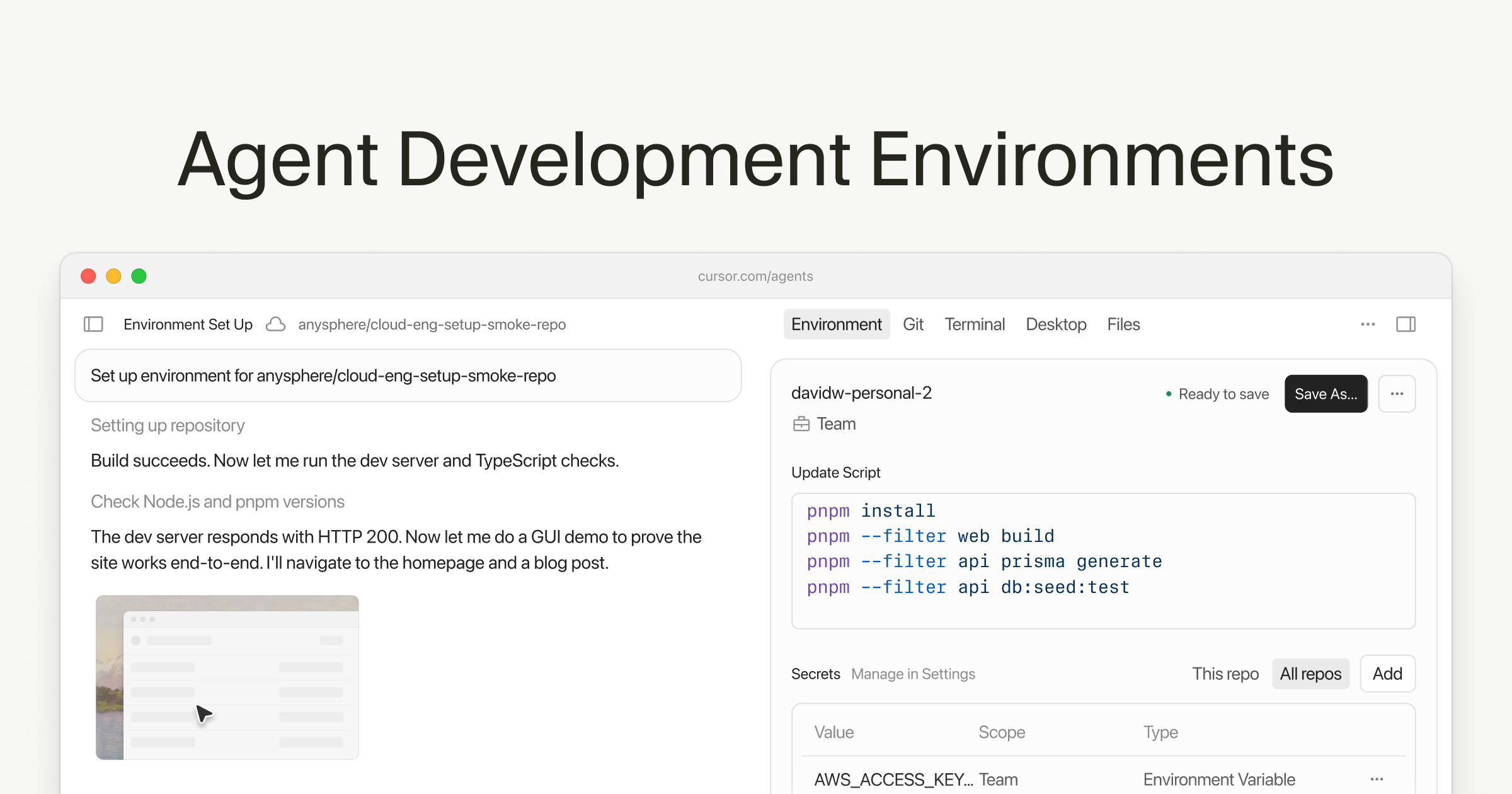
Cursor introduces new tools for configuring cloud agent development environments. The update adds multi-repo support and Dockerfile-based configuration for better environment governance.

Anthropic provides practical guidance for developers integrating Claude's computer and browser use capabilities. Focuses on reliability and efficiency in agentic browser interactions.

Anthropic has released over 20 new MCP connectors and 12 specialized plugins tailored for the legal industry. These tools allow Claude to integrate directly with legal software and automate complex practice-area workflows.
Insights from a massive community experiment exploring AI-assisted ML research. The project highlights the effectiveness of coding agents in quantization and novel model design under strict constraints.

Anthropic's Detection Platform team is leveraging Claude Code to automate alert triage and accelerate security investigations. This demonstrates a practical, high-impact use case for agentic coding tools within security operations.

Amazon outlines new architectural building blocks for optimizing the training and inference of foundation models on AWS. Focuses on scalability and efficiency for large-scale AI deployments.

The Claude Platform on AWS is now generally available, integrating AWS authentication, billing, and commitments. This simplifies deployment for enterprise customers wanting full Claude platform features within their AWS environment.

Anthropic introduces 'Agent View' in Claude Code, providing a centralized interface to manage multiple active Claude Code sessions. This enhances the developer workflow for complex, multi-task agentic coding.

Cursor's Bugbot is transitioning from seat-based subscriptions to usage-based billing for Individual and Teams plans. This change aims to align costs more closely with actual tool utilization.