Prepay for the Gemini API to get more control over your spend
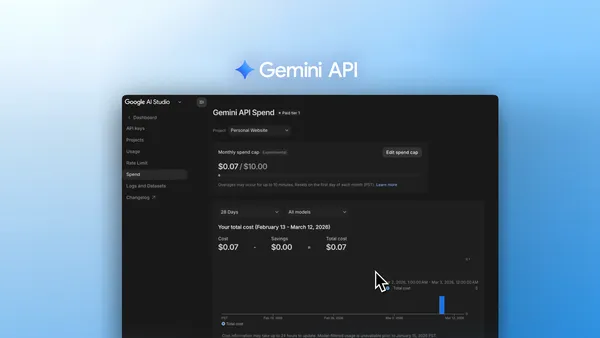
Google AI Studio now supports prepay billing for the Gemini API, allowing developers more precise control over their spending and budget management.
Le meilleur de l'écosystème IA et MCP, sélectionné chaque jour.
Sources

Google AI Studio now supports prepay billing for the Gemini API, allowing developers more precise control over their spending and budget management.

Google Colab added Learn Mode, a set of Gemini-powered features that turn Colab into an interactive coding tutor. It gives developers step-by-step guidance, inline explanations, and targeted exercises inside notebooks — useful for onboarding, teaching, and iterative debugging. This reduces friction for experimenting with Gemini-powered workflows and makes Colab a stronger learning environment for developer-focused model adoption.

Google introduced two new inference tiers for the Gemini API — Flex and Priority — to let developers trade off cost and latency more granularly. Flex is lower-cost with relaxed latency SLAs for background workloads, while Priority offers lower latency for interactive use cases; both aim to reduce wasted spending and make inference choices explicit. This is useful for teams optimizing agent responsiveness and budgets across mixed workloads.

Google released Gemma 4 — their most capable open model family yet, with multimodal understanding and strong performance across reasoning, coding, and instruction following tasks. Designed to run on-device and at edge scale, Gemma 4 closes the gap with frontier closed models while remaining fully open-weight. A significant update to the most widely-used Google open model series.

Google released two developer tools to reduce stale code generation from agents: a Gemini API Docs MCP and complementary Agent Skills that surface up-to-date API docs at runtime. These tools help agents produce current SDK usage and avoid hallucinated or outdated snippets by integrating authoritative API references into the agent stack. For teams deploying coding agents, this reduces developer friction and increases trust in generated code.

Google released Veo 3.1 Lite, a cost-optimized video generation model available in paid preview via the Gemini API and Google AI Studio. For developers, this lowers the barrier to experimenting with programmatic video generation and integrating media workflows into apps without the full compute cost of larger models.

Google launched Gemini 3.1 Flash Live and a Live API in Google AI Studio to power real-time voice and vision agents. This is significant for developers building conversational agents with low-latency audio/video streams and multi-modal state, enabling new live agent use cases like voice assistants and live vision-based workflows.
Google introduced Lyria 3 Pro to bring longer-form music generation into professional Google products, extending Lyria 3's capabilities to creators and production tools. The Pro variant targets workflows that need extended duration and fidelity, making it relevant for apps that programmatically generate soundtracks or adaptive audio. This is significant for developers building media pipelines or tools that embed generative audio.

Google announced Lyria 3, a new music-generation model now available in paid preview via the Gemini API and Google AI Studio. The update expands capabilities for generating longer, higher-fidelity tracks and offers tools for developers to integrate music generation into apps and workflows. For developer-focused products, Lyria 3 opens opportunities for creative tooling and media automation.

Google launched Kaggle Community Hackathons, a turnkey way to host public AI challenges with prize support up to $10,000, lowering barriers for community-driven competitions. The feature includes tooling for event creation, prize handling, and discoverability, which could accelerate crowdsourced benchmarking and dataset curation. Developers and research teams can use it to run reproducible challenges and attract community contributions.

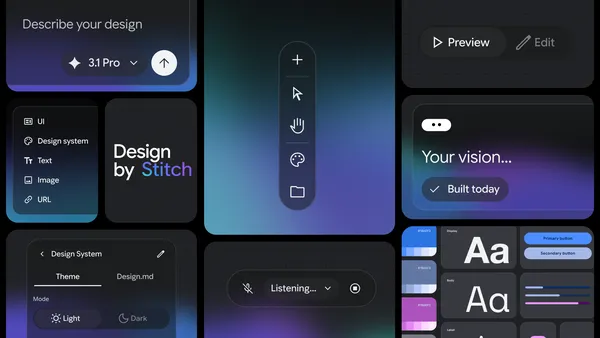
Google's Stitch introduces 'vibe design', an AI-native workflow for creating and iterating high-fidelity UIs collaboratively. For developers and product teams this signals tighter integration between design and AI-assisted generation, potentially speeding prototyping and reducing handoffs between designers and engineers.

Google AI Studio adds a full-stack 'vibe' coding experience with an Antigravity coding agent and Firebase integration, making it easier to build end-to-end apps with AI assistance. This lowers integration friction for developers building production apps that combine model-driven agents with backend services.

Google shipped a batch of Gemini API developer tooling improvements — context circulation for passing state between calls, tool combination patterns for chaining multiple tools in one request, and better streaming support. Incremental but practically useful updates for developers building production agent pipelines on Gemini.

Google introduces features to give developers visibility and control over Gemini API spending, including monthly spend caps and scaling controls. These tools help teams manage costs when integrating large multimodal models into production workflows and reduce surprise bills for experimentation.

Google releases Gemini Embedding 2, a natively multimodal embedding model that maps text, images, video, audio and documents into a single vector space. This simplifies retrieval and multimodal search pipelines for developers building applications that need unified semantic representations across modalities.

Google launched an Opal agent step that lets developers compose dynamic, agentic workflows inside Opal. This provides a first-class building block for chaining model actions and orchestration, lowering friction for developers building multi-step agentic apps.